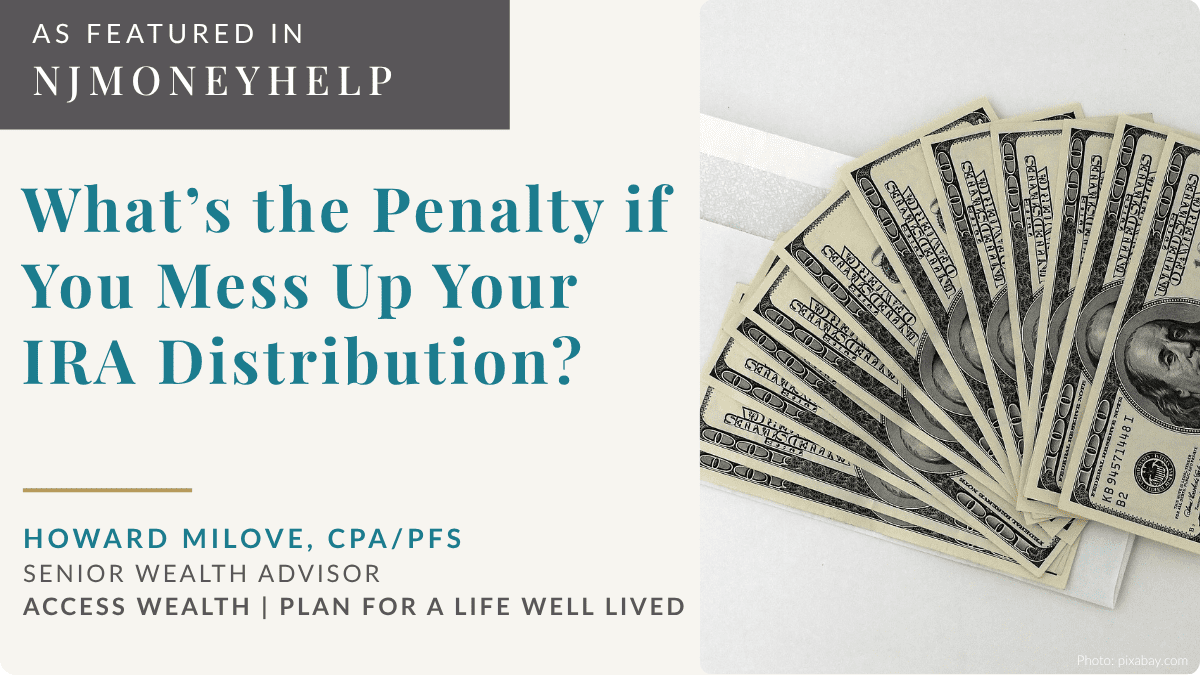
Required Minimum Distributions (RMDs) are an important part of retirement planning, and missing one can lead to costly consequences. In a recent NJ Money Help article, Howard Milove, CPA/PFS, Senior Wealth Advisor at Access Wealth, explains how the rules surrounding missed RMDs have changed under the SECURE 2.0 Act.
In his response, Howard explains that the penalty for failing to take your full RMD has been reduced from 50% to 25%, with the possibility of lowering it further to 10% if the mistake is corrected within two years. He also notes that the IRS may waive the penalty entirely when there is reasonable cause for the error. However, if the required distribution is not taken, the excise tax can continue to apply each year until the correct amount is withdrawn.
Howard also reminds readers that while many custodians calculate RMDs for account holders, the responsibility ultimately rests with the taxpayer. He outlines the basic calculation, explaining that your RMD is determined by dividing your prior year-end account balance by the appropriate life expectancy factor from the IRS Uniform Lifetime Table.
What This Means for You
Required Minimum Distribution rules have become more forgiving, but they’re still important to get right. Reviewing your retirement accounts each year and confirming your RMD calculations can help you avoid unnecessary penalties and keep your retirement income strategy on track.
Read the full NJ Money Help article to learn more about the updated RMD penalty rules and how to calculate your required distribution.
What’s the Penalty if You Mess Up Your IRA Distribution?
Learn more about Howard Milove and how he helps clients plan for retirement and develop a retirement income strategy to achieve and maintain financial independence.